
Practical guide
Baby Shower Decorations — Map the Sightlines Before You Buy Anything
The best-decorated showers aren't the ones with the most stuff — they're the ones where every piece is in the right spot. Map your room's sightlines first, then build focal zones, table layers, and a $650 setup-and-teardown plan for 32 guests.
Quick answer
Plan baby shower decorations as three coordinated zones: the first focal sightline, guest tables, and the food or dessert area. Give the focal zone the strongest theme signal, keep table pieces low and functional, and let the food zone use the simplest repeated color or material. Measure every zone before buying so decor does not replace seating, access, or serving space.
Planning constraints
- Check wall, ceiling, floor, flame, confetti, and cleanup rules before choosing installation methods.
- Test one sample scene at phone-camera distance before producing multiples.
- Include delivery, hardware, inflation, tools, setup labor, removal, tax, and disposal in decor cost.
- Build the safe, stable, readable version first; optional visual layers come last.
Plan baby shower decorations: a complete room plan with a concrete concept, venue guidance, guest-flow advice, a realistic U.S. budget, checklist and a. For baby shower decorations: a complete room plan, the concept and the operating plan need equal attention: one creates delight and the other protects it. Use a whole-room decorating method that creates hierarchy through one focal point, one supporting tablescape, and repeated small cues as the creative north star. All costs are planning estimates in U.S. dollars; replace them with complete local quotes before authorizing a purchase.
Make the process observable
Create a one-page direction sheet with the phrase “a whole-room decorating method that creates hierarchy through one focal point, one supporting tablescape, and repeated small cues,” a swatch for each of one dominant neutral, one main color, one accent, and one natural material, and a measured photograph of home, restaurant, hall, backyard, or studio after measuring walls and circulation. Add only references that answer a production question: height, material, proportion, or sign style. The sheet should let a helper choose between two alternatives without calling the host.
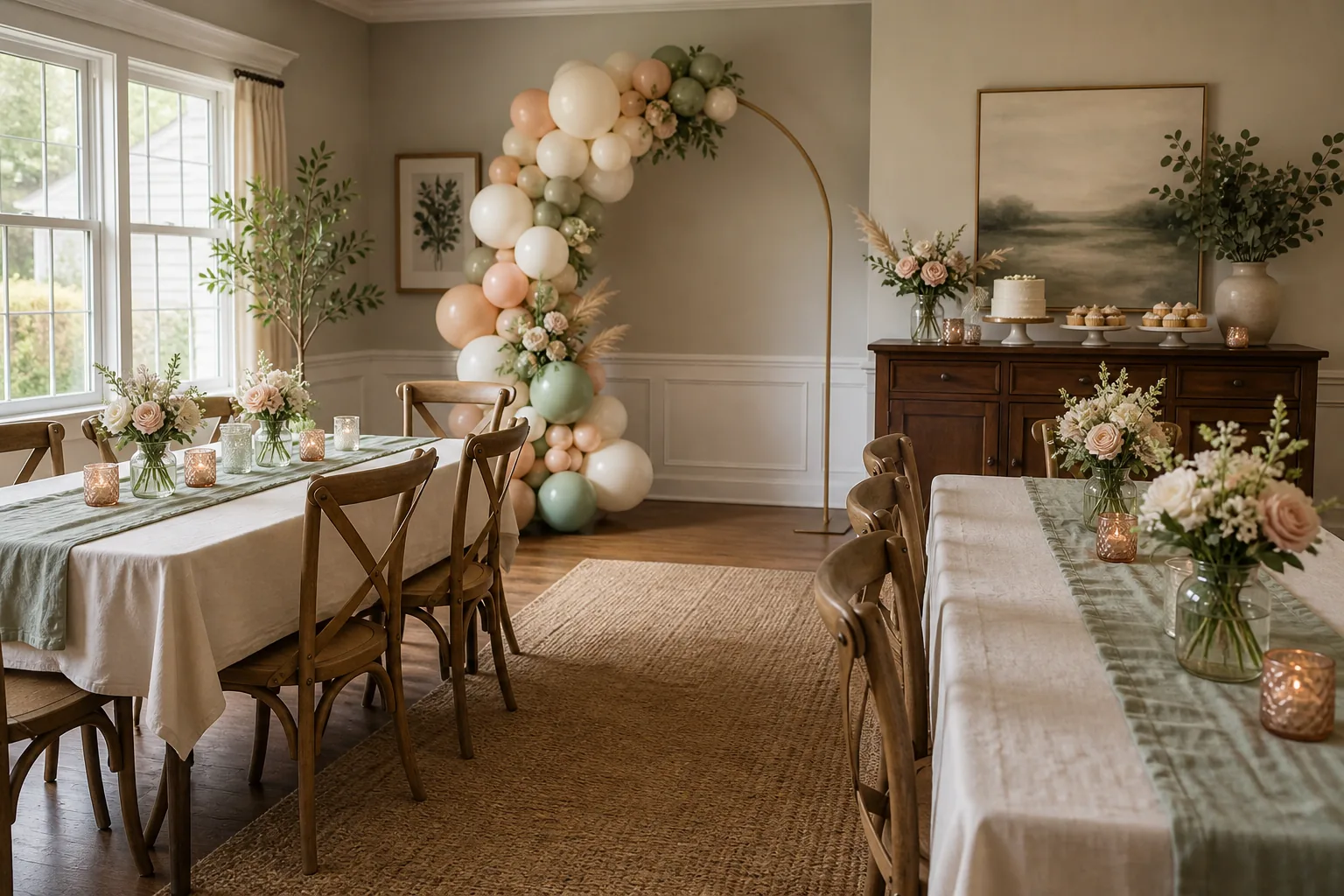
Use a correctly scaled focal scene positioned where guests naturally pause as the primary scene. Place it on a real arrival sightline and give it a second job, such as framing portraits, dessert, or a shared activity. Repeat only two cues elsewhere—perhaps a color in napkins and a material in signs—so the room feels connected without turning every surface into another display.
Photograph the room from the entrance, the guest-of-honor's chair, and the food queue. Those three frames reveal where decoration will actually appear in memories. Spend height and detail inside those frames; leave service corridors quiet. Before ordering, make a scale sketch using wall widths and table lengths. A six-foot garland on a twelve-foot wall and a twenty-inch centerpiece on a dining table are concrete proportions, not inspiration-board guesses.
Fit the idea to home, restaurant, hall, backyard, or studio after measuring walls and circulation
Measure home, restaurant, hall, backyard, or studio after measuring walls and circulation by function: arrival, food service, seating, a decor map assigning each item a location, setup owner, container, and reuse plan, gifts, restroom access, and exit. Keep the gift landing point against a wall and food away from the entry bottleneck. Seat the guest of honor where arrivals are visible without repeated standing, and maintain a continuous accessible path between the entrance, main seat, food, and restroom.
Choose the backup while choices are still inexpensive. Verify capacity, restrooms, parking, power, and permission for the alternate arrangement, then save a message that can reach every guest. If the focal installation cannot be used, preserve the concept with a tabletop version based on one dominant neutral, one main color, one accent, and one natural material instead of improvising new purchases.
Design the experience around the guests
For this gathering, decor must preserve accessible paths, clear signs, safe overhead heights, stable tables, and room for strollers. Convert that into an arrival plan and an actual seat count. The honoree should be able to greet people without standing repeatedly; guests should be able to reach food and restrooms without crossing equipment. Use clear ingredient labels and protect special portions from shared utensils.
Open quietly, transition into food, and reserve the clearest instructions for a decor map assigning each item a location, setup owner, container, and reuse plan. A single helper should be able to run it without the host repeating the rules. Close with a stated final moment and enough time to sort gifts and leftovers before the venue deadline or household fatigue takes over.
A realistic U.S. budget for this version
Use $650 as a working ceiling for this version of Baby Shower Decorations: A Complete Room Plan. The figure is a complete category model, not a quote or a reason to spend every dollar. Reprice it after the attendance count and site are known, and do not assume professional labor, delivery, or cleanup will be donated.
- Food and nonalcoholic drinks — $208: a menu suited to the event hour, water, an appealing zero-proof drink, ice, ingredient labels, and a small portion buffer for baby shower decorations: a complete room plan.
- Venue or home readiness — $117: reservation or household preparation for home, restaurant, hall, backyard, or studio after measuring walls and circulation, including access, cleaning, parking, permits, and any comfort equipment not already included.
- Decor and flowers — $130: the materials that complete a correctly scaled focal scene positioned where guests naturally pause, plus readable signs and restrained table accents in one dominant neutral, one main color, one accent, and one natural material.
- Rentals and service pieces — $78: only the seating, linens, serving equipment, delivery, setup, or pickup required by the measured plan at home, restaurant, hall, backyard, or studio after measuring walls and circulation.
- Activities and favors — $46: all supplies, instructions, display materials, and packing needs for a decor map assigning each item a location, setup owner, container, and reuse plan, with a modest take-home detail if the budget allows.
- Tax, tips, and contingency — $71: applicable tax and gratuity plus a protected reserve for the disruption most likely to affect baby shower decorations: a complete room plan.
Review the budget with the room plan beside it. A purchase that has no location, owner, setup time, or guest benefit is a candidate to remove. Preserve the food, site readiness, and reserve first; simplify styling in complete layers so the remaining design still reads as intentional. For Baby Shower Decorations: A Complete Room Plan, apply this decision to the specific venue, activity, and guest count above.
Action checklist
First commitments
- Define the finished result for baby shower decorations: a complete room plan and the decisions required to reach it.
- Confirm the date, guest ceiling, $650 cap, host roles, and boundaries with the honoree.
- Record dependencies so invitations, orders, and quantities are not finalized out of sequence.
- Give each open item an owner and decision deadline rather than a vague “work on it” status.
Production and confirmations
- Build one sample of a correctly scaled focal scene positioned where guests naturally pause and correct its scale, stability, and color before producing the rest.
- Finalize the menu, service method, seating, rentals, and supplier arrival windows.
- Test a decor map assigning each item a location, setup owner, container, and reuse plan from instructions through cleanup and assign a lead who is not the primary host.
- Reconcile RSVPs with dietary notes, seats, portions, labels, and activity quantities.
Final week and event day
- Pack by function and label the containers for arrival, food, focal setup, tables, guest care, a decor map assigning each item a location, setup owner, container, and reuse plan, and cleanup.
- Place the measured venue map, supplier numbers, fallback trigger, and short run of show in the first container opened.
- Chill drinks, confirm safe food holding, charge devices, and stop optional crafting the night before.
- At home, restaurant, hall, backyard, or studio after measuring walls and circulation, establish access and service first, complete a correctly scaled focal scene positioned where guests naturally pause second, and add expendable detail only if the schedule allows.
Mistakes that weaken this specific plan
The plan loses clarity when the host starts buying isolated pretty objects without designing sightlines or scale. Return to the stated direction—a whole-room decorating method that creates hierarchy through one focal point, one supporting tablescape, and repeated small cues—and keep only the strongest evidence of it. A complete focal scene, comfortable seating, and dependable food service will read as intentional even when secondary decoration is restrained.
Protect the honoree's arrival by assigning another person to approve setup questions and receive suppliers. Finish safety, food, seating, and the main scene before optional touches. The cleanup owner should know where gifts, cards, leftovers, rentals, and trash go, and should photograph home, restaurant, hall, backyard, or studio after measuring walls and circulation before the final handoff.
Related planning guides
Continue with Neutral Baby Shower Ideas with Warmth to settle the next operational choice; Compare Boho Baby Shower Ideas for another direction that shares part of this plan; Use The Complete Baby Shower Checklist for a complementary constraint. Keep one attendance figure and the $650 ceiling across those guides so their advice becomes a sequence of decisions rather than separate shopping lists.
Frequently asked questions
How early should I plan baby shower decorations: a complete room plan?
Start six to eight weeks ahead for a typical gathering. Book home, restaurant, hall, backyard, or studio after measuring walls and circulation first if availability is limited, then confirm the guest list, invitation date, menu, and correctly scaled focal scene positioned where guests naturally pause.
What is a realistic budget for this plan?
A useful working example is $650 for the venue, food, decor, rentals, activities, and contingency described in this guide. Adjust the guest count before cutting comfort or food safety.
How can I adapt the idea for fewer guests?
Keep decor map assigning each item a location, setup owner, container, and reuse plan, reduce table and food quantities, and concentrate decor into the main sightline. A smaller group benefits from one shared table and more conversational activities.
What should I avoid when planning this shower?
The most common mistake is buying isolated pretty objects without designing sightlines or scale. Make the venue, guest comfort, and one recognizable concept pass a final review before buying secondary details.
Sources and review notes
- Babylist baby shower planning checklist for theme timing and final-week production.
- 2010 ADA Standards for Accessible Design for route-clearance context when floor decor or furniture moves are proposed.
- USDA buffet food-safety guidance for keeping decor from interfering with hot and cold holding.
Reviewed by the Baby Shower AI Planner editorial team on August 8, 2026. Venue permission and manufacturer instructions take priority for every installation.
Turn this guide into an editable plan
The plan now has a defined point of view, a measured site, a guest-aware schedule, a $650 allocation, and named handoffs. Keep those decisions together when attendance or quotes change. Use that handoff specifically for Baby Shower Decorations: A Complete Room Plan.
Open the AI planner with this guide's preset and keep the output editable. Before ordering, compare every generated recommendation with the confirmed venue rules, guest access and dietary needs, written supplier totals, and the final spending ceiling.