
Practical guide
Baby Shower Planning Timeline — Lock the Expensive Stuff Early, Decorate Last
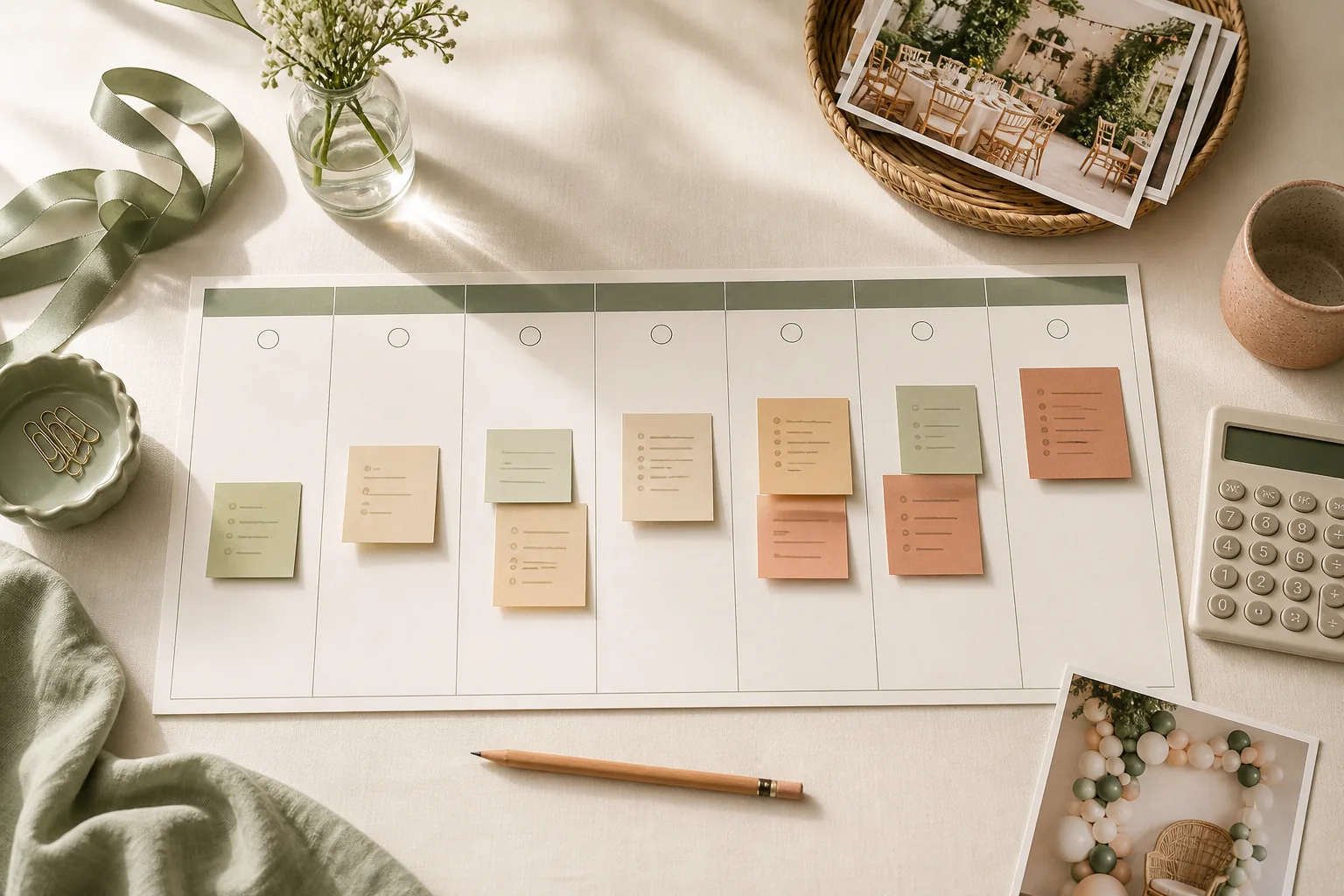
Venues, caterers, and rentals book up fast and get pricier last-minute. Lock those in at week 6, then handle invitations by week 4, and save decorating for the final 48 hours. A week-by-week timeline for 35 guests on $750.
Quick answer
For a typical baby shower, begin six to eight weeks ahead: settle the budget, host team, guest list, date, and venue first; send invitations and book suppliers next; finalize food, seating, decor, and activities after early RSVPs; then use the final week for counts, packing, pickups, and confirmations rather than new design decisions.
Planning constraints
- Move venue-dependent work earlier for parks, restaurants, rentals, holidays, and high-demand dates.
- Give each task one owner, one due date, and a definition of done that another helper can verify.
- Pair every deposit deadline with its cancellation and final-count deadline.
- Close optional purchases 72 hours before setup so the team can focus on readiness.
Plan baby shower planning timeline: week-by-week with a concrete concept, venue guidance, guest-flow advice, a realistic U.S. budget, checklist and a. A coherent baby shower planning timeline: week-by-week plan makes trade-offs early, while the venue, guest count, and supplier options are still flexible. This guide develops a backward scheduling system that places irreversible decisions early and saves flexible creative work for later. The dollar amounts are U.S. examples and include often-missed charges such as tax, delivery, service, ice, and last-minute consumables.
Solve the operational bottleneck
Begin at the entrance to any venue, with extra lead time for public parks, restaurants, rentals, or holiday weekends. Decide what guests should understand in the first five seconds, then use the chosen palette locked after venue and theme approval to lead the eye there. Check the proposal from seated height as well as standing height. This prevents a dramatic idea from blocking conversation or disappearing behind food and people.
Let a shared calendar with decision dates, payment dates, pickup windows, and named owners carry the theme's most literal expression. Keep nearby food labels and wayfinding simpler, with enough contrast to remain readable. Photograph a sample at phone-camera distance and remove anything that merges into visual noise. One resolved scene plus restrained supporting moments is more persuasive than a room of partially finished ideas.
Put each task on the calendar according to the cost of changing it. Venue and guest-count decisions belong first because they affect every quote. Menu quantities, seating, and printed names wait for the RSVP checkpoint. Flowers, groceries, and chilled drinks sit close to event day. This sequence prevents an early decorative choice from locking the host into a room, count, or service plan that later proves unworkable.
Fit the idea to any venue, with extra lead time for public parks, restaurants, rentals, or holiday weekends
For any venue, with extra lead time for public parks, restaurants, rentals, or holiday weekends, draw doors and their swing, fixed furniture, outlets, windows, and the narrowest passage. Place food where replenishment does not cross the welcome route. Give coats, gifts, packaging, and waste separate destinations. Those unglamorous zones prevent the finished room from becoming cluttered fifteen minutes after guests arrive.
Create a reduced configuration that keeps the meal, seating, and primary experience when time or space shrinks. Decide which decorative element disappears first and where a seventy-two-hour readiness review that closes open tasks before setup day moves. Share the cutover time with helpers so they do not continue building a version the venue or weather no longer supports.
Design the experience around the guests
Plan around the fact that early invitations help travelers and caregivers while a firm RSVP date protects food, chairs, favors, and activity quantities. Review the entrance, seating, menu, and a seventy-two-hour readiness review that closes open tasks before setup day through that lens rather than adding “accessibility” as a final checklist item. Offer a polished zero-proof drink, give dietary questions a private response route, and communicate any unavoidable steps, grass, gravel, or parking distance before event day.
Plan roughly 165 minutes and distinguish fixed deadlines from flexible moments. Food holding, supplier departure, and site checkout need exact times; photographs and mingling can expand or contract. That distinction lets the host recover from a late arrival without pushing every remaining part of baby shower planning timeline: week-by-week behind schedule.
A realistic U.S. budget for this version
Plan this version against a $750 maximum, then track estimated, committed, and paid amounts separately. The cap includes ordinary charges that are easy to miss—ice, service pieces, delivery, sales tax, and final supplies—so the host can see the true remaining balance.
- Food and nonalcoholic drinks — $240: a menu suited to the event hour, water, an appealing zero-proof drink, ice, ingredient labels, and a small portion buffer for baby shower planning timeline: week-by-week.
- Venue or home readiness — $135: reservation or household preparation for any venue, with extra lead time for public parks, restaurants, rentals, or holiday weekends, including access, cleaning, parking, permits, and any comfort equipment not already included.
- Decor and flowers — $150: the materials that complete a shared calendar with decision dates, payment dates, pickup windows, and named owners, plus readable signs and restrained table accents in the chosen palette locked after venue and theme approval.
- Rentals and service pieces — $90: only the seating, linens, serving equipment, delivery, setup, or pickup required by the measured plan at any venue, with extra lead time for public parks, restaurants, rentals, or holiday weekends.
- Activities and favors — $53: all supplies, instructions, display materials, and packing needs for a seventy-two-hour readiness review that closes open tasks before setup day, with a modest take-home detail if the budget allows.
- Tax, tips, and contingency — $82: applicable tax and gratuity plus a protected reserve for the disruption most likely to affect baby shower planning timeline: week-by-week.
Attach each full quote to its category and enter the payment deadline. Grocery plans still need platters, foil, storage, labels, and ice; rental proposals may add delivery and pickup. If the total crosses $750, change one substantial choice while cancellation is possible instead of trimming every category until none feels finished.
Action checklist
First commitments
- Define the finished result for baby shower planning timeline: week-by-week and the decisions required to reach it.
- Confirm the date, guest ceiling, $750 cap, host roles, and boundaries with the honoree.
- Record dependencies so invitations, orders, and quantities are not finalized out of sequence.
- Give each open item an owner and decision deadline rather than a vague “work on it” status.
Production and confirmations
- Build one sample of a shared calendar with decision dates, payment dates, pickup windows, and named owners and correct its scale, stability, and color before producing the rest.
- Finalize the menu, service method, seating, rentals, and supplier arrival windows.
- Test a seventy-two-hour readiness review that closes open tasks before setup day from instructions through cleanup and assign a lead who is not the primary host.
- Reconcile RSVPs with dietary notes, seats, portions, labels, and activity quantities.
Final week and event day
- Pack by function and label the containers for arrival, food, focal setup, tables, guest care, a seventy-two-hour readiness review that closes open tasks before setup day, and cleanup.
- Place the measured venue map, supplier numbers, fallback trigger, and short run of show in the first container opened.
- Chill drinks, confirm safe food holding, charge devices, and stop optional crafting the night before.
- At any venue, with extra lead time for public parks, restaurants, rentals, or holiday weekends, establish access and service first, complete a shared calendar with decision dates, payment dates, pickup windows, and named owners second, and add expendable detail only if the schedule allows.
Mistakes that weaken this specific plan
Avoid doing attractive tasks first while contracts, guest data, and food logistics remain unresolved. The remedy is a pre-purchase review that covers scale, venue permission, total landed cost, setup owner, and destination after the event. When one answer is missing, delay the order. That pause is cheaper than repairing a cluttered room or unsafe installation on event morning.
Delegate finished outcomes, not general help. A useful assignment names the zone, container, reference, deadline, and person authorized to make a small substitution. Keep supplier contacts, arrivals, food checks, the fallback, gift handling, and closeout on a one-page run sheet so the guest of honor never becomes the dispatcher. For Baby Shower Planning Timeline: Week-by-Week, apply this decision to the specific venue, activity, and guest count above.
Related planning guides
Compare The Complete Baby Shower Checklist for a complementary constraint; Use Baby Shower Food Ideas for Every Style of Party to settle the next operational choice; Continue with Baby Shower Games Guests Will Actually Enjoy for another direction that shares part of this plan. Keep one attendance figure and the $750 ceiling across those guides so their advice becomes a sequence of decisions rather than separate shopping lists.
Frequently asked questions
How early should I plan baby shower planning timeline: week-by-week?
Start six to eight weeks ahead for a typical gathering. Book any venue, with extra lead time for public parks, restaurants, rentals, or holiday weekends first if availability is limited, then confirm the guest list, invitation date, menu, and shared calendar with decision dates, payment dates, pickup windows, and named owners.
What is a realistic budget for this plan?
A useful working example is $750 for the venue, food, decor, rentals, activities, and contingency described in this guide. Adjust the guest count before cutting comfort or food safety.
How can I adapt the idea for fewer guests?
Keep seventy-two-hour readiness review that closes open tasks before setup day, reduce table and food quantities, and concentrate decor into the main sightline. A smaller group benefits from one shared table and more conversational activities.
What should I avoid when planning this shower?
The most common mistake is doing attractive tasks first while contracts, guest data, and food logistics remain unresolved. Make the venue, guest comfort, and one recognizable concept pass a final review before buying secondary details.
Sources and review notes
- Babylist baby shower planning checklist for the reference two-month planning sequence.
- National Weather Service outdoor-event safety for adding forecast monitoring and a weather decision time.
- USDA buffet food-safety guidance for final-week food holding and event-day service checks.
Reviewed by the Baby Shower AI Planner editorial team on August 8, 2026. Move deadlines earlier when contracts, travel, or holidays require it.
Turn this guide into an editable plan
Use this guide as the shared brief for baby shower planning timeline: week-by-week: one source for scope, venue facts, costs, responsibilities, and fallback choices. Use that handoff specifically for Baby Shower Planning Timeline: Week-by-Week.
Open the AI planner with this guide's preset and keep the output editable. Before ordering, compare every generated recommendation with the confirmed venue rules, guest access and dietary needs, written supplier totals, and the final spending ceiling.